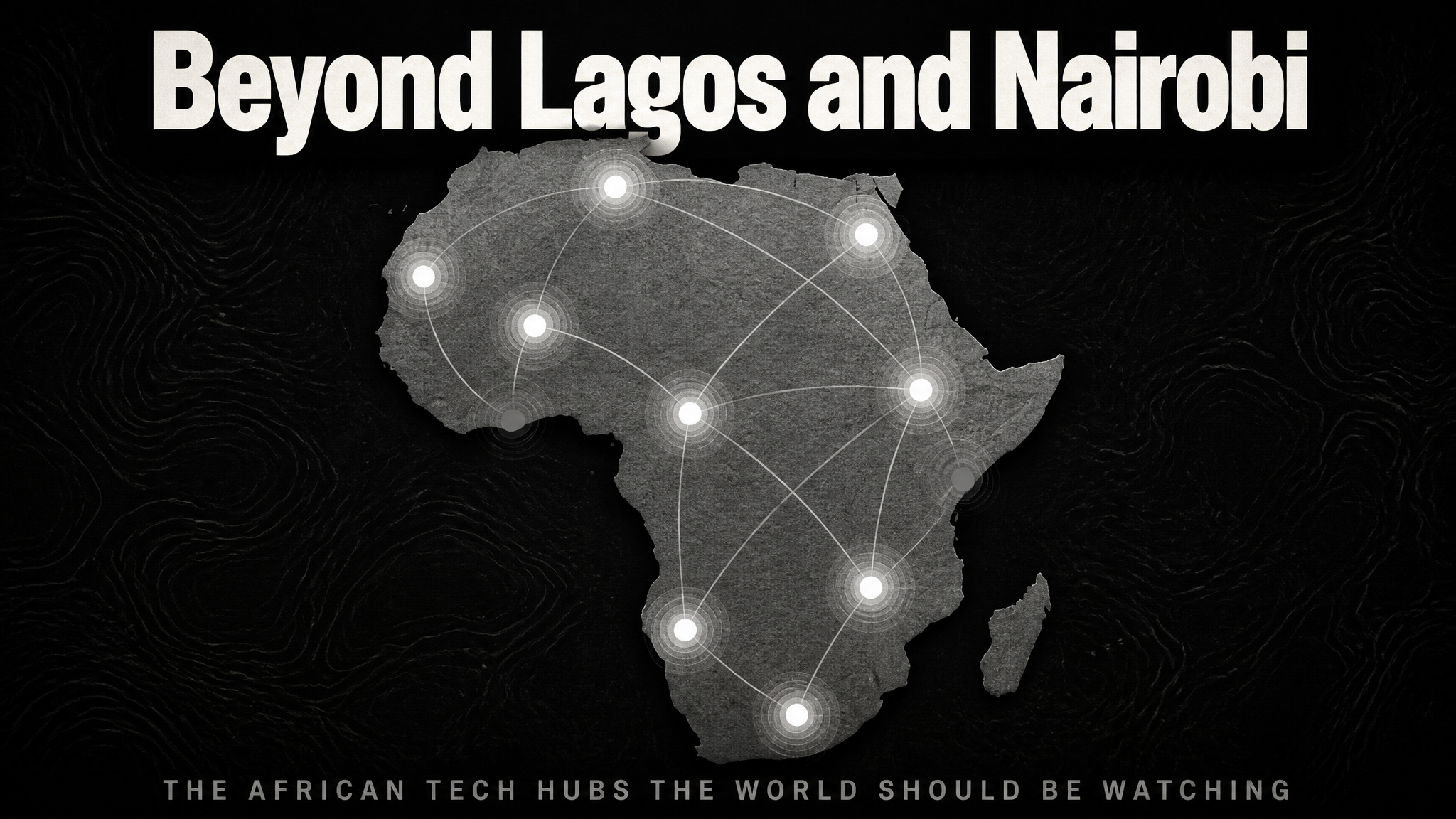
When the global technology industry talks about Africa, a familiar group of cities tends to dominate the conversation.
Lagos. Nairobi. Cape Town. Johannesburg. Cairo.
And for good reason.
These markets have large technology ecosystems, established investors, major corporations, strong startup communities and significant amounts of venture capital.
But Africa’s technology story is much bigger than its most recognisable hubs.
Across the continent, a new generation of technology ecosystems is emerging, and some of the most interesting opportunities may be found outside the traditional centres of African tech.
A continent of different technology markets
Africa does not have a single technology ecosystem.
It has dozens.
The needs of a fintech operating in Egypt can be completely different from those of a startup building for farmers in Zambia. A digital-health company in Rwanda may face a very different market from a payments company in Senegal.
This diversity is one of Africa’s greatest advantages\, but it also makes the continent difficult to understand from the outside.
The established hubs remain extremely important.
Partech’s 2025 data shows that Kenya, South Africa, Egypt and Nigeria together attracted 72% of African technology funding in 2025. Kenya led total funding at US$1.04 billion, followed by South Africa at US$715 million, Egypt at US$604 million and Nigeria at US$572 million.
But those numbers also raise another question:
What is happening in the other 51 countries?
Kigali: building around digital government
Rwanda has positioned itself as one of Africa’s most ambitious digital economies.
The country’s technology story extends beyond startups. Digital public services, smart mobility, financial inclusion and emerging technologies have become important parts of its development agenda.
Companies such as Irembo and Zipline have demonstrated how technology can be applied to public services and healthcare, while Kigali’s broader ecosystem has attracted entrepreneurs and international technology companies.
Dakar: West Africa’s digital challenger
Senegal has developed a growing technology ecosystem around fintech, digital payments, logistics and software.
Companies such as Wave and Paps illustrate how startups can emerge from local market needs and build products capable of expanding across borders.
The broader Francophone African market also presents an opportunity that can sometimes be overlooked by English-language technology coverage.
Casablanca and Cairo: North Africa’s technology opportunity
North Africa offers a different proposition.
Egypt has one of the continent’s largest technology markets and remains a major destination for technology investment. Morocco, meanwhile, is developing opportunities around fintech, payments, software, manufacturing technology and startups.
These markets also provide an important bridge between African, Middle Eastern and European business ecosystems.
Lusaka: an ecosystem worth watching
Zambia may not yet attract the same amount of venture capital as Nigeria, Kenya or South Africa, but its technology ecosystem is developing across fintech, digital payments, telecommunications, e-commerce, agritech and digital public services.
The opportunity is particularly interesting because technology adoption is increasingly moving beyond consumers and into businesses, government and other sectors of the economy.
The next wave may not come from the usual places
The concentration of capital in four markets does not necessarily mean those markets will capture every major opportunity.
Technology ecosystems develop over time.
They need entrepreneurs, capital, infrastructure, talent, customers, supportive regulation and access to regional markets.
The African Continental Free Trade Area could become particularly important as technology companies look beyond their domestic markets. The UN Economic Commission for Africa has highlighted digital platforms, artificial intelligence, advanced manufacturing and energy technologies as potential drivers of Africa’s economic transformation, while pointing to regional integration as an important part of unlocking that potential.
The next major African technology company may therefore come from an established hub.
Or it may come from somewhere that receives far less attention today.
That is why Africa Tech will be looking beyond the usual headlines.
Because Africa’s technology future will not be built in five cities. It will be built across a continent.
Leave a Reply